

Mergers and Acquisitions: A Complete Legal Guide to Buying and Selling a Business in Los Angeles
A business can look immaculate in a pitch deck and still have contracts that are about to expire, intellectual property nobody properly assigned, or liabilities that never made it into the presentation. The numbers may be attractive. The opportunity may be real. The fine print, however, has its own version of events.
Buying or selling a business involves far more than agreeing on a price. The parties must decide what is changing hands, investigate the business, negotiate how risks will be allocated, and document what happens if expectations do not match reality.
For business owners, private equity firms, investors, and technology companies in Los Angeles, understanding the legal process can help prevent avoidable disputes and keep a promising transaction on track. Here is how the major stages fit together, and where careful legal planning makes a difference.
1. Choose the Right Deal Structure Before Negotiating the Details
One of the first decisions in a merger or acquisition is determining what the buyer will actually acquire. The transaction structure influences the assets involved, the treatment of liabilities, the transfer of contracts, tax considerations, and the approvals needed to close.
Three structures are particularly common.
Asset Purchases
In an asset purchase, the buyer acquires specified assets of a business, potentially including equipment, inventory, intellectual property, customer relationships, and selected contractual rights. The agreement identifies which liabilities the buyer will assume and which will remain with the seller, subject to applicable law.
This structure can give buyers greater control over what they acquire. But transferring individual assets may require assignments, third-party consents, new permits, or other steps. Certain liabilities may also arise by operation of law despite the parties’ contractual allocation.
Equity Purchases
In an equity purchase, the buyer acquires ownership interests in the target company, such as its shares or membership interests. The company generally continues to own its assets and remain responsible for its obligations.
That continuity can make an equity acquisition attractive when preserving the company’s contracts, operations, and existing structure is important. It also makes diligence essential: the buyer is acquiring an entity with a history, not simply selecting its most appealing assets.
Statutory Mergers
A statutory merger combines entities through a process governed by applicable corporate law. The required approvals, filings, treatment of ownership interests, and other legal consequences depend on the entities involved and the transaction’s structure.
California’s merger statutes address matters such as merger agreements, approval procedures, and filings. A merger should therefore be evaluated against the specific requirements that apply to the participating entities, rather than treated as a shortcut around the usual transaction formalities.
Comparing the Main M&A Structures
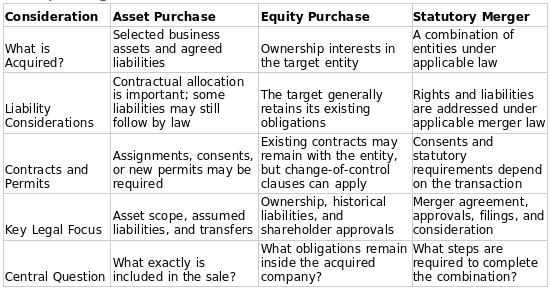
No structure is automatically best. Buyers may prioritize flexibility and risk allocation, while sellers may focus on tax consequences, transaction complexity, and the obligations they will retain. The parties should assess the legal and tax implications with qualified advisers before committing to a structure.
For companies considering a transaction, an experienced Los Angeles M&A lawyer can help identify these issues early, when the parties still have room to negotiate rather than having to redesign a deal halfway through the process.
2. Use the Letter of Intent to Establish the Commercial Ground Rules
Once the parties have a preliminary understanding of the transaction, they often document their intentions in a letter of intent (LOI) or term sheet.
An LOI is meant to establish a framework for negotiations. It should not leave the parties guessing about the fundamental economics or the process they are agreeing to follow.
Important terms may include:
· Purchase Price and Structure: The proposed price, the form of consideration, and whether the transaction is an asset purchase, equity purchase, or merger.
· Exclusivity: Whether the seller must refrain from negotiating with other potential buyers for a defined period.
· Confidentiality: How the parties may use and disclose sensitive financial, operational, and commercial information.
· Due Diligence: What records the buyer may review, who will provide access, and the expected timetable.
· Closing Conditions: The approvals, consents, financing, or other requirements anticipated before completion.
· Timing and Expenses: Target dates, responsibility for transaction costs, and what happens if negotiations end.
A critical distinction is whether particular provisions are binding or nonbinding. An LOI may state that the proposed transaction remains subject to definitive agreements while making confidentiality, exclusivity, expenses, or other specified provisions binding.
The label on the document is not the entire answer; the wording and applicable law matter. Parties should understand what they are committing to before signing.
For sellers, exclusivity deserves particular attention. Agreeing to take a business off the market can consume valuable time and reduce negotiating leverage. For buyers, an LOI should establish a workable diligence process without implying that every issue has already been resolved.
The goal is straightforward: establish enough agreement to justify the next stage without accidentally creating obligations that neither side intended.
3. Conduct Due Diligence That Tests the Deal's Assumptions

Due diligence is where an attractive opportunity meets the underlying facts. It is not simply a request for documents. It is a structured investigation into whether the business is worth the proposed price, whether it can operate as expected after closing, and which risks require additional protection.
The scope should reflect the company's industry, size, structure, and operational complexity.
Financial and Tax Review
Buyers typically examine financial statements, tax filings, debt obligations, revenue trends, working capital, customer concentration, and unusual expenses. Where appropriate, a quality-of-earnings review can help distinguish recurring operating performance from temporary or nonrecurring results.
A company reporting strong revenue may still have weak cash flow, significant collection problems, or a dependency on one customer. The headline numbers matter, but so does the quality behind them.
Contracts and Legal Obligations
Review material customer and supplier agreements, leases, financing documents, litigation, guarantees, and other commitments. Particular attention should go to provisions triggered by a sale, assignment, merger, or change of control.
A major customer contract may be valuable only if it survives the transaction. A lease may restrict assignment. A lender may require consent before ownership changes. These issues can affect valuation, timing, and even whether the proposed deal is viable.
Employment and Management
Examine employment agreements, compensation arrangements, incentive plans, benefits, contractor relationships, and any outstanding employment disputes. Identify which key employees are essential to continued operations and whether their continued participation is realistic.
A buyer is acquiring a business, not a guarantee that every important employee will stay.
Intellectual Property and Technology
For technology companies, this review deserves particular depth. Investigate ownership of software, source code, patents, trademarks, trade secrets, domain names, and other important intellectual property.
Confirm that founders, employees, and contractors have properly assigned relevant rights where required. Review third-party software licenses, open-source obligations, data rights, privacy practices, and customer commitments relating to security or service availability.
A product may be technically impressive and commercially successful, but uncertainty over who owns its underlying code can become a serious transaction problem.
Regulatory, Operational, and California-Specific Issues
Assess applicable industry regulations, permits, licenses, insurance, real estate arrangements, and operational dependencies. Requirements vary by business, so a buyer should not assume that the seller's approvals automatically transfer.
California's Department of Tax and Fee Administration (CDTFA) specifically advises buyers to seek tax and fee clearance when purchasing a business. It also explains that a buyer may need a new seller's permit or other account because these are not transferable. If applicable liabilities remain unpaid and the necessary clearance has not been obtained, the buyer may face exposure under California's rules. The relevant requirements should be addressed well before closing. See the CDTFA's guidance on buying and selling a business.
What Happens When Diligence Uncovers a Problem?
A finding should lead to a decision. The parties might renegotiate the price, require a liability to be resolved before closing, obtain a third-party consent, add a specific indemnity, or exclude an asset from the transaction. In some circumstances, the finding may justify ending negotiations under the applicable agreement.
The buyer should not treat representations in the purchase agreement as a replacement for investigating the business. The seller, meanwhile, should disclose information accurately and work with counsel to ensure that material exceptions are properly documented.
A useful rule is this: if a diligence finding matters enough to worry about, it matters enough to address in the deal documents.
4. Look Beyond the Headline Price
The purchase price attracts attention because it is easy to quote. The mechanics of payment determine what the parties actually receive, when they receive it, and how the amount may change.
Several mechanisms can materially affect the economics of a transaction.
Purchase-Price Mechanisms and Their Practical Effects
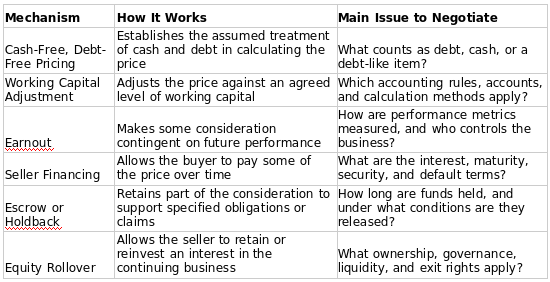
These mechanisms are not required in every deal. Their usefulness depends on the parties' objectives, financing, risk tolerance, and bargaining positions.
Working Capital: A Small Definition With Large Consequences
Consider a hypothetical acquisition in which the parties agree on a price assuming the business will deliver a specified level of working capital at closing. The final calculation shows a shortfall.
Depending on the agreement, that shortfall may reduce the amount payable to the seller. But the result can turn on the definition of working capital, the treatment of particular accounts, the accounting principles used, and whether the agreement provides a clear reconciliation and dispute-resolution process.
The lesson is to negotiate the formula before the closing calculation becomes contentious.
Earnouts create a different challenge. If part of the price depends on future revenue or earnings, the agreement should explain the metric, measurement period, accounting treatment, access to records, and process for resolving disputes. Sellers should also consider whether the buyer's post-closing operating decisions could materially affect the result.
A purchase price is only as clear as the rules used to calculate and pay it.
5. Negotiate the Purchase Agreement With Precision
The definitive purchase agreement turns the parties' commercial understanding into a detailed set of rights, obligations, conditions, and remedies. It is one of the most important documents in the transaction because it addresses both the deal the parties expect and the problems they hope will not occur.
Representations and Warranties
Representations and warranties are statements about the business or transaction. They may cover financial information, taxes, contracts, litigation, employees, ownership, intellectual property, compliance, and other matters relevant to the acquisition.
Buyers generally want assurances that important facts are accurate. Sellers want statements that are carefully defined, appropriately qualified, and consistent with what has been disclosed.
Disclosure schedules are central to this process. They identify exceptions to particular representations and provide additional information required by the agreement. A seller should not assume that a general disclosure in one document necessarily qualifies every relevant representation.
Covenants Before and After Closing
Covenants establish what the parties must do, or refrain from doing, during specified periods. Between signing and closing, these may address ordinary-course operations, access to information, preservation of assets, and efforts to obtain required consents.
Post-closing covenants may cover transition services, delivery of records, cooperation with tax matters, or other continuing obligations.
The scope and duration should be clear. Broad obligations that sound reasonable during negotiations can become burdensome when the parties are no longer working toward the same immediate goal.
Closing Conditions and Termination Rights
Closing conditions specify what must occur before the parties are required to complete the transaction. Depending on the deal, these may include approvals, required consents, financing, regulatory clearance, or compliance with contractual obligations.
Termination provisions should explain when a party may end the agreement, whether notice or a cure period is required, and what consequences follow. These provisions become especially important when diligence reveals a material issue or a closing deadline approaches without the required approvals.
Why Legal Drafting Matters
Precision is not about making an agreement longer. It is about making the parties' obligations understandable and enforceable, with fewer gaps for later disagreement.
A buyer should know what protections exist if a representation proves inaccurate. A seller should know which statements it is making, what has been disclosed, and what exposure may continue after closing.
Working with an M&A attorney in Century City or elsewhere in Los Angeles can help the parties align the purchase agreement with the actual economics and risk profile of the transaction, rather than relying on boilerplate that may not fit the deal.
6. Plan for Indemnification Before a Claim Arises
Representations and warranties describe what the parties are saying about the transaction. Indemnification provisions address when one party may have to compensate the other for specified losses.
These provisions are often heavily negotiated because buyers and sellers have different, legitimate concerns. Buyers want meaningful remedies if a material statement proves inaccurate or an agreed obligation is breached. Sellers want to avoid open-ended exposure that makes it impossible to know when the transaction is truly behind them.
Key terms may include:
· Scope of Covered Losses: Which losses, claims, costs, or liabilities may be recoverable, and what exclusions apply.
· Survival Periods: How long particular representations or obligations remain subject to claims, subject to the contract and applicable law.
· Baskets and Deductibles: Thresholds that must be reached before certain claims can be recovered.
· Caps: Limits on the amount recoverable for specified claims, with negotiated exceptions where appropriate.
· Escrow or Holdback: Funds retained for a defined period to support certain obligations or claims.
· Specific Indemnities: Tailored protections for identified risks uncovered during diligence.
· Representations and Warranties Insurance: Insurance that may be available in certain transactions, subject to underwriting, exclusions, retention, and policy limits.
These protections are not interchangeable. An escrow may provide a source of funds, for example, but it does not by itself define which claims are valid. Insurance may address certain losses but will not necessarily cover every contractual risk.
The agreement should also establish how claims must be noticed, documented, defended, and resolved. Without a clear process, even a legitimate claim can turn into a separate dispute about procedure.
For sellers, the key is understanding the full extent of post-closing exposure before accepting the deal. For buyers, it is confirming that the protections negotiated are practical and meaningful, not merely reassuring language in a long agreement.
7. Get the Transaction Ready for Closing
Signing the purchase agreement does not always mean the business changes hands immediately. Some transactions sign and close on the same day; others require additional time to satisfy closing conditions.
Depending on the structure and circumstances, the parties may need to complete:
· Board, shareholder, member, or other required internal approvals
· Third-party consents under customer contracts, leases, financing documents, or other agreements
· Regulatory reviews or approvals where applicable
· Financing arrangements, payoff letters, and agreed debt releases
· Transfer documents, certificates, and other closing deliverables
· Required tax, permit, and licensing steps
Certain larger acquisitions may also be subject to federal premerger notification requirements under the Hart-Scott-Rodino Act. Whether a filing is required depends on the applicable thresholds, transaction details, and exemptions. Where the law requires notification and a waiting period, the parties generally cannot close until that period has expired or the relevant agencies permit closing. The Federal Trade Commission's premerger notification guidance provides further information.
The parties should maintain a closing checklist that assigns responsibility for each item, identifies deadlines, and tracks outstanding conditions. It is much easier to resolve a missing consent before the scheduled closing than to discover that a critical contract cannot be transferred when everyone is ready to sign.
8. Protect the Value of the Deal After Closing
Closing is a major milestone, but it is not necessarily the end of the parties' legal obligations. The business still needs to operate, information must be transferred, and certain financial or contractual matters may remain unresolved.
Post-closing planning should address the following.
Final Purchase-Price Adjustments

If the agreement provides for a working capital or other price adjustment, the parties may need to prepare closing statements, exchange supporting records, and resolve disagreements under the agreed procedure.
Clear deadlines and accounting rules can help prevent a relatively small calculation from becoming a disproportionate dispute.
Transition and Operational Handover
The buyer may need support transferring customer relationships, supplier arrangements, records, software access, and operational knowledge. If the seller has agreed to provide transition services, the agreement should specify the services, duration, compensation, and limits of the seller's responsibilities.
Technology acquisitions require particular care. Access to source code, cloud services, customer data, security systems, and technical documentation should be handled through a planned and secure process.
Continuing Claims and Performance Obligations
Indemnification claims, earnout calculations, deferred payments, and other obligations may continue after closing. The parties should preserve relevant records and follow the agreement's notice, reporting, and dispute-resolution procedures.
For sellers, post-closing cooperation should have defined boundaries. For buyers, the transition plan should identify the knowledge, access, and contractual rights needed to operate the acquired business without unnecessary disruption.
The strongest transactions treat integration and post-closing administration as part of the deal from the beginning, not as a list of tasks to improvise after the funds have moved.
FAQs
Should I sign a letter of intent before agreeing on the purchase price?
You can, but the parties should understand which economic terms remain open and which provisions will be binding. A preliminary price may be acceptable if the LOI clearly identifies the assumptions, diligence process, exclusivity obligations, and remaining negotiations. The more significant the commitment, the more important it is to review the document before signing.
Can a buyer reduce the purchase price after due diligence?
A buyer can propose a price adjustment when diligence uncovers new information, but it cannot necessarily demand one. The answer depends on the parties' agreements, any applicable conditions or termination rights, and the nature of the finding. The issue should be addressed through negotiation or the remedies available under the transaction documents.
What happens if a major customer contract requires consent to the acquisition?
The parties should determine whether the contract's assignment or change-of-control provisions are triggered and what approval is required. If consent is necessary, the agreement may make obtaining it a closing condition or otherwise allocate the risk of failure. Ignoring the clause can put an important revenue source at risk.
Can I be held responsible for problems discovered after I sell my business?
Potentially. A seller's post-closing exposure depends on the representations, disclosures, indemnification provisions, negotiated limits, and other terms of the agreement, along with applicable law. Sellers should understand which obligations survive closing and how long claims may be brought. Buyers should ensure the negotiated remedies address the risks that matter to them.
How do buyers protect themselves if working capital is lower than expected?
The purchase agreement should define the target working capital, explain how it is calculated, identify the accounting principles that apply, and establish a process for reviewing and disputing the closing statement. A price-adjustment mechanism can address a shortfall, but only if the calculation rules are sufficiently clear.
What legal issues matter most when buying a technology company?
Ownership and control of intellectual property are central. Buyers should review software and code ownership, employee and contractor assignments, third-party and open-source licenses, data rights, privacy practices, customer contracts, and technology dependencies. They should also confirm that the company can continue operating its product and services after closing without losing essential rights or access.
Does buying a company's shares mean I inherit all its liabilities?
The target company generally continues to hold its own obligations after an equity acquisition. The buyer acquires ownership of that entity, so historical liabilities can affect the value of the investment and the company's operations. Diligence, contractual protections, and the specific facts determine how those risks should be addressed.
What California tax and permit issues should I resolve before closing?
Identify which permits and tax accounts apply to the business and determine whether new registrations are required. The CDTFA advises buyers to request tax and fee clearance to address potential outstanding liabilities and explains that seller's permits are not transferable. Other state, local, or industry-specific requirements may also apply.
Can a seller receive part of the purchase price after closing?
Yes. Depending on the deal, some consideration may be paid through an earnout, seller financing, deferred payment, or another agreed arrangement. Each approach carries different risks. The agreement should clearly define payment timing, performance conditions, interest, security where relevant, and the consequences of default or disagreement.
When should I hire an M&A attorney, before signing the LOI or afterward?
Ideally, involve counsel before signing the LOI. Early advice can help you evaluate the deal structure, identify problematic binding terms, establish diligence protections, and negotiate the commercial framework. Waiting until the definitive agreement is drafted may mean trying to change positions that have already been agreed to or committed to in writing.
Make the Deal Work on Paper and in Practice
A successful acquisition or sale is not measured by the headline price alone. It depends on whether the parties understand what is being transferred, identify the material risks, negotiate workable protections, and plan for the obligations that continue after closing.
At Alex Nahai Law, we help businesses navigate important corporate transactions with a focus on the legal details that support sound commercial decisions. Whether you are preparing to sell a company, evaluating an acquisition, or planning a strategic transaction, we can help you assess the issues, structure the deal, and negotiate the agreements that move it forward.
If you are considering a transaction in Los Angeles, Beverly Hills, or Century City, contact us to discuss how we can support your next step with practical, business-focused legal guidance.